
Coconino County Criminal Docket Searches
Begin with the court named on the citation, release paper, or charging document. Felonies land in the Superior Court in Coconino County. A Justice Court can hold a felony's first appearance and preliminary events, plus state-law misdemeanors. City misdemeanors and ordinance cases stay in Municipal Court. One incident can carry more than one case number across these courts. A Superior Court-only docket search may miss the lower-court file.
The free Arizona Judicial Branch Public Access to Court Information is the best starting index. It uses a CAPTCHA and splits case, minute-entry, and notice functions. A case number works best as the key. With only a name, check the court. Then check the case type and filing date. Confirm the party role before trusting a match.
- Identify the court and copy the full case number from a court paper when possible.
- Pass the Public Access CAPTCHA, then use the case search or limited Minute Entry Search.
- Open the matching criminal case and check its court, status, charge rows, dated events, and newest hearing.
- Compare the next setting with the Coconino County weekly calendar, then confirm changes with division staff.
- Use eAccess or ask the correct clerk for the filed document when an event label alone is not enough.
Coconino County Criminal Docket Divisions
Administrative Order 2026-05 splits the felony caseload among Superior Court Divisions I, II, and III in roughly equal shares. The same order carves out specific work. Division I takes Early Resolution and restoration-of-rights matters. Division III takes bail eligibility, limited-jurisdiction appeals, and Veterans Treatment Court. These assignments explain the judicial officer and division labels a Coconino County criminal docket displays.
Assignments shift when a later administrative order issues, so the case header and newest filed notice control. A division label is not a charge result. It also says nothing about whether a hearing happened. Read the dated events and the hearing block too.
Criminal Dockets: What They Show
A Coconino County criminal docket is a case history, not the whole file. The header identifies the case. Read each charge row separately. Counts can carry different statuses. Event rows prove a pleading, motion, minute entry, or order was filed. The title alone is not the signed document. Hearing entries may list courtroom, setting type, date, and result.
| Case number | A criminal Superior Court number commonly uses the CR category and year; exact punctuation and length vary by court. |
|---|---|
| Case information | Filing date, title, category, status, court location, and assigned judicial officer. |
| Public parties | Participant roles and counsel when release is allowed; victim and witness data are excluded. |
| Charges | Statute, description, classification, and a separate disposition field that may be blank while pending. |
| Events | Dated entries with a preview, purchase control, or a notice that the document is not available online. |
| Hearings | Courtroom, date, hearing type, and any entered result. |
Read status, charges, events, and hearings together. A pending case can show several finished hearings. A blank disposition does not prove dismissal, and a hearing result may stay blank until the court enters it.
Coconino County Criminal Docket Terms
Bond and release entries deal with custody conditions, never guilt. A change-of-plea event marks a plea hearing; a conviction or acquittal is the charge result. Sentencing comes later. It records the court's penalty after a qualifying outcome. Probation events can appear long after judgment. The newest entry is not always the case outcome.
- Pending
- No final result has been entered for the charge.
- Dismissed
- The charge ended without a conviction; the signed order supplies the reason and scope.
- Convicted
- A guilty result was entered by plea or adjudication.
- Acquitted
- A not-guilty result was entered after adjudication.
- Remanded
- A higher court sent the matter back for further action.
Note: Coconino County publishes no local abbreviation table for these criminal dockets. Never guess at an unexplained code. Ask the clerk, or pull the related minute entry or order.
Criminal Case Stages on the Docket
A felony often opens with a complaint and initial appearance in Justice Court. A preliminary hearing or grand-jury indictment may follow. In Coconino County Superior Court, the docket can then show arraignment and plea, disclosure, conferences, motions, a change of plea or trial, a verdict or other disposition, sentencing, and probation work. Paths vary. Not every case reaches trial.
Docket flow: Filing › Arraignment › Pretrial › Plea or Trial › Disposition › Sentencing
Follow the dates, not the page title. A motion only asks for action. The later order shows what the judge did. An appealed limited-jurisdiction case keeps its original history separate from the new Superior Court appeal docket.
Coconino County Criminal Docket Weekends
Coconino County posts a special weekend and federal-holiday initial-appearance schedule. Those proceedings start at 8:30 a.m. An initial appearance covers identity, release, counsel, and next steps. It is not a trial. It settles nothing about the charge.
That schedule explains a first setting. The regular calendar does not cover it. Check the newest case event, then confirm time and access with the court. A later arraignment or pretrial date may appear in a different division.
Coconino County Criminal Docket Courts
Criminal files in Coconino County sit with more than one clerk. Felony cases and Superior Court appeals belong to the Coconino County Clerk of the Superior Court. Misdemeanor, traffic, and preliminary felony files stay with the Flagstaff, Fredonia, Page, and Williams Justice Courts. Each keeps its own. The Municipal Courts in those same towns handle city-code, city misdemeanor, and city traffic cases. Even where courts share a building in Page or Williams, the files remain separate.
For Superior Court matters, the clerk holds the complete file. The address is 200 N. San Francisco Street in Flagstaff. Call (928) 679-7600 with questions. The counter opens at 8:00 a.m. It closes at 5:00 p.m. on weekdays except holidays. A lower-court matter goes to that Justice or Municipal clerk instead. Public Access spans many participating courts. It leaves out local-ordinance charges by design.
Coconino County Criminal Docket eAccess
Need documents, not just index lines? Arizona eAccess serves eligible open Superior Court civil and criminal cases filed on or after July 1, 2010. It stands apart from the free weekly index. A Coconino County criminal docket search there can filter by Coconino Superior Court, case type CR, or a filing and event date range. Case number, case title, participant name, judicial officer, or event description also work. Advanced mode accepts AND, OR, and NOT terms.
Results arrive ten per page by default and can be sorted. Export sits behind a CAPTCHA and stops at 1,000 results. A broad term works better once you narrow by court, case type, and date. Any given event may show Preview, Add to Cart, or “Document Not Available Online.” That last label only blocks the online purchase. The underlying Coconino County criminal docket event still exists.
Is an image missing? Call or visit the Coconino County Clerk of the Superior Court. A mailed copy inquiry should give the case number. Include the document title and date, the desired copy type, and the delivery address. Then ask about current research, page, certification, postage, payment, and processing terms. The Coconino County docket search page details the number and name paths.
Coconino County Specialty Criminal Dockets
Coconino County runs three named specialty programs in its criminal system. These are Recovery Court, Mental Health Court, and Veterans Treatment Court. Current assignments put Recovery Court in Division V. Mental Health Court sits in Division II. Veterans Treatment Court sits in Division III. Reviews and other public court events usually ride on the underlying criminal case number. So do not expect a separate public specialty-court docket.
Keep limits in mind, too. The public event history does not open treatment, medical, or other restricted program records. Recovery Court may list court review dates while the treatment details stay protected. That line between a public setting and a restricted file matters most. It matters most when reading specialty entries in a Coconino County criminal docket.
Coconino County Criminal Docket Orders
A Coconino County criminal case history may note that an order or sentencing entry was filed. Filed is not the same as decided. When the exact ruling matters, get the signed document itself. The local clerk keeps the complete Superior Court file. It includes items that neither Public Access nor eAccess shows. Anyone can inspect in person through the proper office. Access rules apply. Mail requests work too, once the clerk confirms the current amount and accepted payment. Arizona's official criminal-record sealing statute explains why. The online picture can be incomplete.
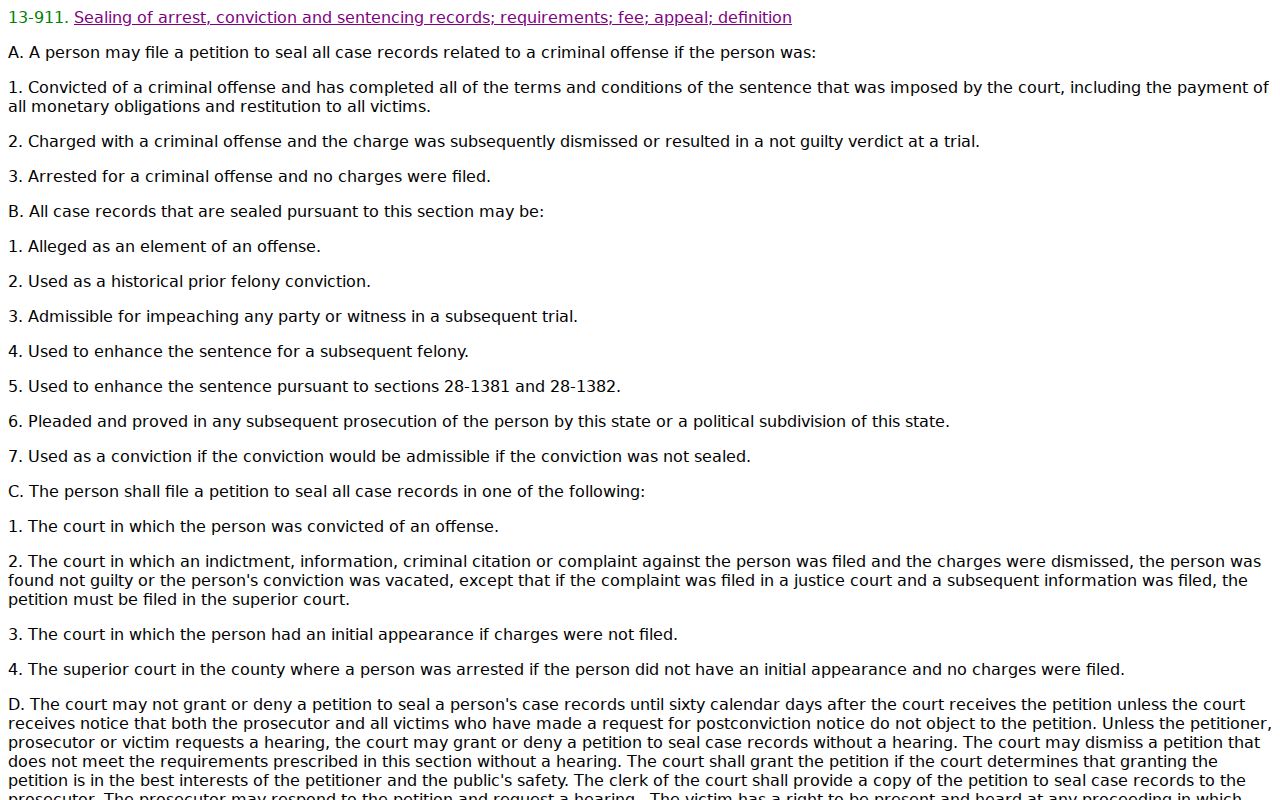
The statute view drives the point home. A blank online result alone cannot establish that no Coconino County criminal case exists.
Access Rules for Criminal Dockets
Access to judicial records in Arizona runs through Supreme Court Rule 123. The rule starts from public access. It then shields listed confidential or restricted material. It also gives the court custodian a process for requests and denials. A.R.S. § 39-121, the general public-record principle, does not override that court-specific rule. When a public judicial record is not routinely posted, a sufficiently clear Rule 123 request is the formal fallback for a Coconino County court docket.
Key access rules:
Arizona Supreme Court Rule 123 sets the main public-access and restriction framework for court records.
A.R.S. § 13-911 creates a petition and court-order process for sealing eligible criminal case records.
A.R.S. § 8-208 limits access to juvenile court records.
Free Public Access leaves out sealed matters and protection orders. It also leaves out mental-health and probate cases, victim and witness information, and juvenile delinquency or incorrigibility cases. Updates land on Friday with information through Wednesday. A missing Coconino County entry can also mean the wrong venue, an older file, a spelling issue, or a nonparticipating court. For an official result, ask the court that maintains the record. Request a certified copy of the court docket entry.
Coconino County Criminal Docket Updates
A weekly state refresh and a live courtroom run on different clocks. Public Access can lag a hearing reset today. Coconino County's weekly division calendars are expressly nonofficial and subject to change. Sources can conflict. Weigh the newest filed notice or minute entry, the current weekly calendar, and a direct call to division staff.
Keep the old date in your notes. A prior calendar row can explain the sequence. The later docket event establishes the reset. The Coconino County confirmation chain runs case history, current calendar, assigned division, and then the clerk. The clerk matters when a filed record is needed.
Note: a calendar row confirms a listed setting. It is not the final outcome of any charge in the Coconino County criminal docket.