
Coconino County Court Docket Searches
Find the court name first. It sits on any filed paper, citation, or hearing notice you already have, and it decides where the record lives. From there, the Arizona Judicial Branch Public Access case lookup is the free statewide starting point. Most Arizona courts feed it public case information. Updates run weekly, though, and the site itself is not the official record. A precise case number is your best search key. Party names also work, but shared spellings and the wrong court choice can return a flood of matches or nothing at all.
Why so many routes? Coconino County courts each keep their own files. Superior Court matters rest with the Coconino County Clerk of the Superior Court. Justice Courts hold limited civil, eviction, misdemeanor, and county traffic files. City traffic, misdemeanor, and ordinance cases sit with municipal clerks. Follow this order:
- Read the paper or citation and identify the named court.
- Open Public Access, complete its CAPTCHA, and choose case search.
- Search the exact case number, or narrow a name search to the court.
- Review status, public parties, events, and the newest hearing entry.
- Confirm a setting or request the complete record from that court's clerk.
A blank result is not proof the matter is gone. It usually means you should check venue. Weekly lag can explain it. So can a local ordinance, a sealed or excluded case type, an older paper file, or a court that does not participate. The complete Superior Court file stays with the local clerk either way.
Coconino Docket Access Has Three Layers
Arizona splits docket access into three layers. The first layer is the free Public Access tool. It shows public case information and limited minute entries for Coconino County matters. The second layer is eAccess, a paid service for people eligible to view Superior Court civil and criminal documents filed on or after July 1, 2010. The third layer sits offline. The Coconino County Clerk of the Superior Court holds the complete local court file. That office issues official copies when you need them. Knowing which layer answers your question saves time and fees.
| Layer | Best Use | Key Limit |
|---|---|---|
| Public Access | Find a public case and event history | Weekly, incomplete, and nonofficial |
| eAccess | Preview or buy eligible filed images | Paid and limited by date, type, and access rules |
| Local clerk | Inspect the full file or order certification | Fees and court-specific request steps apply |
The county's own Web-Based Services explanation lays out this split plainly. A docket entry can exist even when no document image is available to download, and an image you pull online is never the same thing as a certified copy.
Court Dockets: What They Show
Open a Coconino County court docket and you will usually see the basics first: the court, case number, filing date, case category, status, and the judicial officer assigned to the case. Party names and their roles may come next. From there, the case history walks through dated filings, minute entries, orders, hearings, and a disposition once one has been entered. Some lower-court cases also show financial data. Keep one thing in mind. Each line is a record of an event, not a copy of the filed paper, and it may not spell out the judge's full ruling.
| Case Number | The court's identifier, often beginning with a category such as CR or CV. |
|---|---|
| Case Status | A current label such as pending, closed, or disposed, subject to the latest entry. |
| Parties | Public names and roles that are legally releasable. |
| Case History | Dated filings, minute entries, settings, orders, and later events. |
| Hearing Setting | Date, type, courtroom, and result when those fields are entered. |
| Disposition | The recorded result for a case, claim, or individual charge. |
Read the entries in date order. A motion entry only proves a request was filed. It is not a ruling. The docket does not tell you the motion was granted. When an order entry appears and its terms matter, track down the signed order itself. In a criminal case, expect a separate result for each charge.
Coconino Docket Numbers Signal Case Type
Arizona case numbers begin with letters that reveal the case type. In a Coconino County court docket, CR usually marks a criminal case. CV marks a civil one, and DO a domestic relations matter. Probate cases carry PB. Guardianship and conservatorship work shows up as GC. Juvenile cases may use JV or JD. The letters are followed by a year and a running sequence. Punctuation and length can differ from court to court.
- Case information
- The statewide portal's public summary, not a certified court record.
- Case history
- The dated list of filings, hearings, orders, and outcomes.
- Minute entry
- The court's written record of a proceeding or ruling.
- Setting
- A scheduled hearing, conference, trial, or other court event.
Copy the whole number from an official notice when you can. A partial case number sometimes works in eAccess. An exact court paired with the full number cuts down false matches and keeps your Coconino County docket search on target.
Coconino County Courts and Their Dockets
Arizona Superior Court is a single statewide court of general jurisdiction, sitting in every county. Coconino County has six Superior Court divisions. They handle felonies, larger civil matters, family law, probate, juvenile cases, and other general-jurisdiction work. Four Justice Courts take limited civil claims, small claims, evictions, misdemeanors, county traffic, and the early stages of felony proceedings. City traffic, misdemeanors, and ordinance cases go to the Municipal Courts. The Coconino County Superior Court overview places the county court at the center of that structure.
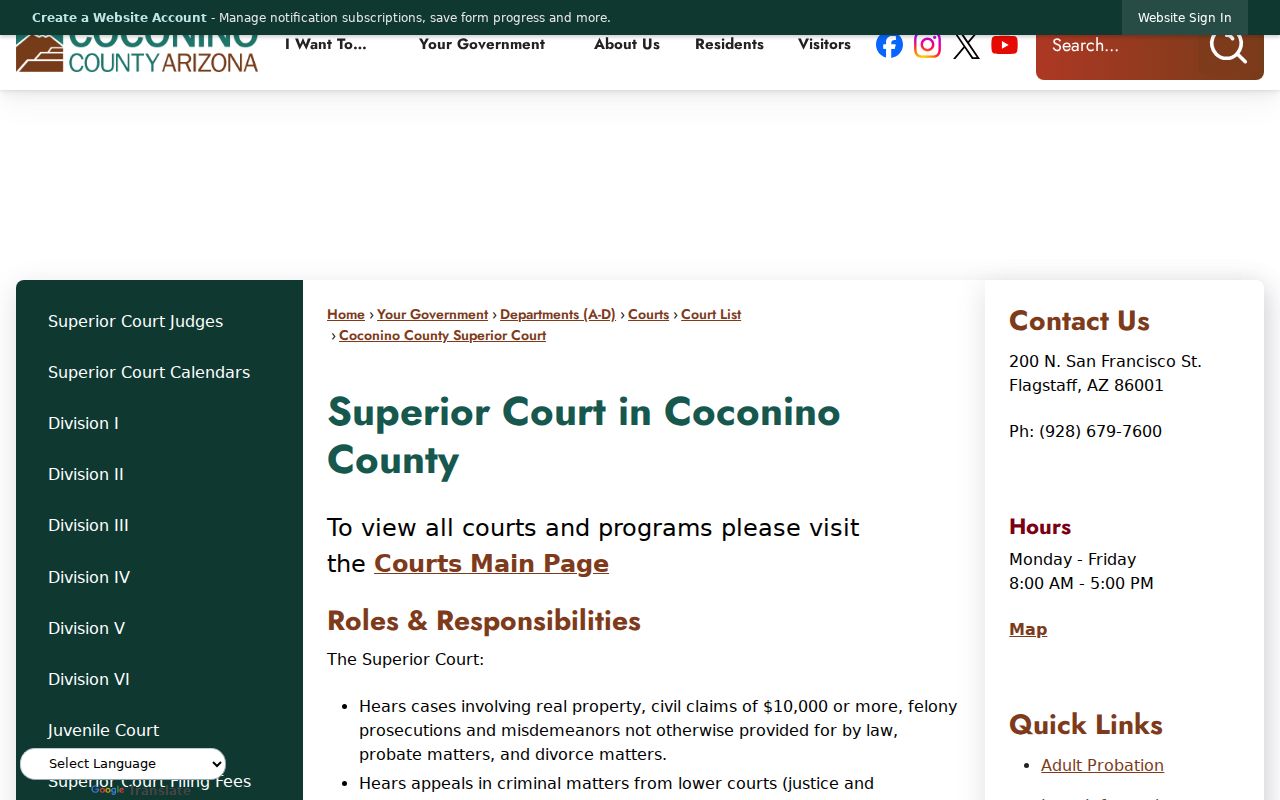
The county page lays out how the courts fit together. Each lower court still keeps its own records with its own clerk.
| Court | Docket Covers | Where to Search |
|---|---|---|
| Superior Court in Coconino County | Felony, general civil, family, probate, juvenile | Public Access, eAccess, or Superior Court clerk |
| Flagstaff, Fredonia, Page, Williams Justice Courts | Limited civil, small claims, eviction, misdemeanor, county traffic | Public Access and the named Justice clerk |
| Municipal Courts | City traffic, misdemeanors, and ordinances | Public Access where included, then municipal clerk |
| Federal District Court | Federal civil and criminal matters | PACER, not the county docket |
Coconino Dockets Span Vast Distances
Coconino County stretches across 18,616.36 square miles. It counted roughly 144,368 residents in 2025. Distances matter here. A court docket could sit in a courthouse two hours from where you live. So the name of the court on any Coconino County court record is the first thing to check. Tribal, federal, state, county, and city authorities all hold pieces of the justice system. The county softens the drive by keeping Distributed Justice Courts in Flagstaff, Fredonia, Page, and Williams. That means lower-court files stay close to home rather than piling up in Flagstaff.
A statewide docket search does not reach every tribunal inside Coconino County. Tribal court dockets sit outside it entirely. Federal matters that qualify land in the U.S. District Court for Arizona instead. If you cannot tell which court owns a Coconino County case number, stop and check the issuing agency or the case paper before trusting a name match.
Court Dates and Settings in Coconino County
Coconino County publishes weekly PDF calendars for Superior Court Divisions I through VI and for Juvenile Court on its Superior Court Calendars page. One schedule row can carry the day, the time, the attorneys, the case number, the public case name with roles, and the type of proceeding. Expect labels like arraignment, pretrial, sentencing, law and motion, and resolution management conference. Each PDF also lists the time it was last updated.
Find your row by case number first. Then check it against the newest docket event. Recheck near the hearing date, since a continuance or reset can shift a setting after the PDF went up. Treat the calendar as unofficial. It can contain an error or omission. A filed notice, a minute entry, or direct confirmation from the assigned division or clerk carries more weight. The Coconino County court schedule lays out every channel in detail.
Initial appearances run at 8:30 a.m. on weekends and federal holidays under a dedicated county notice. Virtual participation follows whatever current court orders and notices say. Never reuse an old meeting link.
Coconino Weekly Calendars Are Nonofficial
Think of a calendar row as a planning note. It is not the certified Coconino County court docket. A row survives a reset because it shows what the court intended to hear, yet it cannot promise the event is still on. The judge may later continue the hearing and a fresh row appears. Read both dates together for the real story.
Confirm before appearing: check the PDF timestamp, review the newest case event, and call the assigned court when the sources conflict.
Distance makes this practical. Page sits roughly 130 miles from Flagstaff, and Fredonia runs its own Justice Court. Remote tools can spare a long drive. Still, only the court can tell you whether a hearing stays in person, goes virtual, or has moved.
Docket Access Under Arizona Law
Rule 123 of the Arizona Supreme Court governs who may see judicial records. Access is the presumption. The rule then carves out restricted material. It sets conditions for requests, and it explains how denials get reviewed. Arizona's general public-record statute supports inspection of public officer records, but it does not replace this court-specific rule. Electronic access carries its own statutory authority and fees.
Key Arizona access rules:
Arizona Supreme Court Rule 123 governs judicial-record access and the custodian's response.
A.R.S. § 39-121 states Arizona's general public-record inspection principle.
A.R.S. § 12-284.01 authorizes electronic court-record access and related fees.
A.R.S. § 13-911 establishes the petition process for sealing eligible criminal records.
The Arizona Justice Courts overview helps place limited-jurisdiction records within this system.
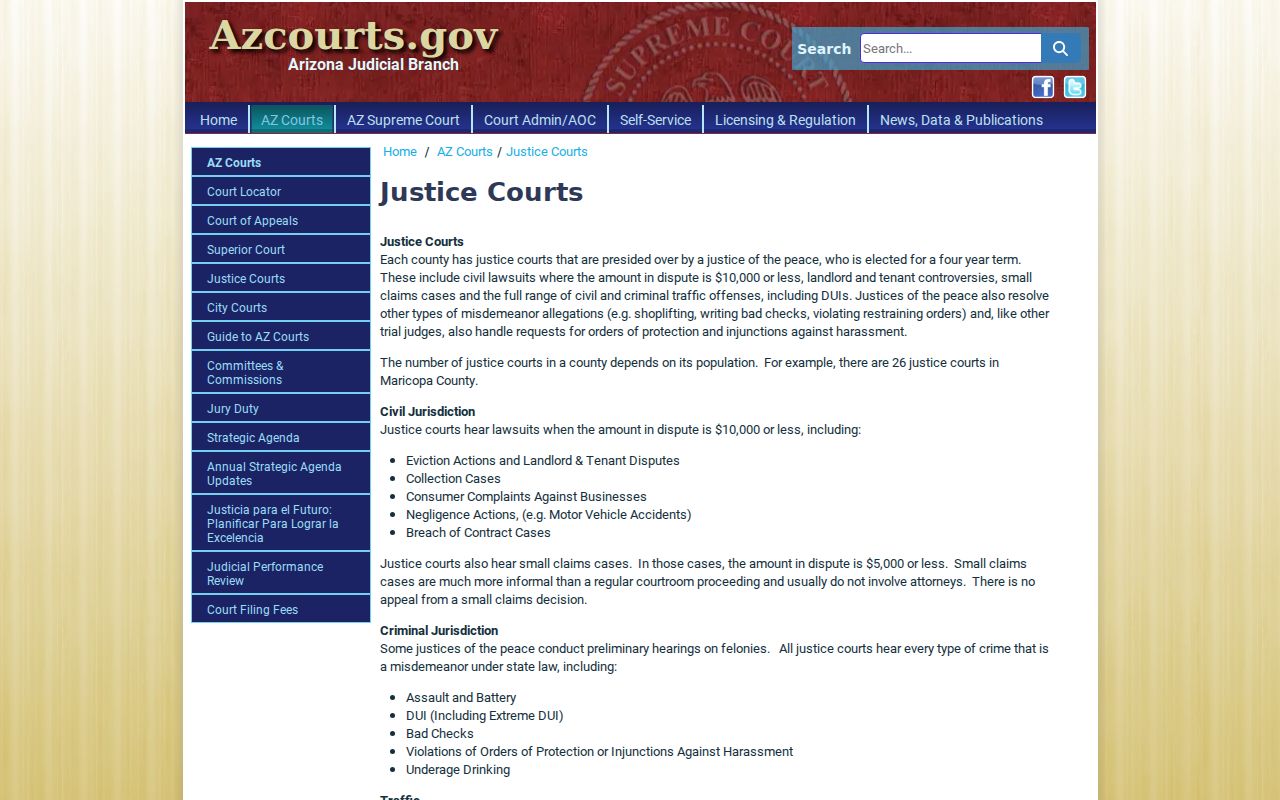
Why request a Justice Court file from that court rather than the Superior Court clerk? The state source answers exactly that.
Coconino Docket Searches Omit Some Matters
Public Access leaves out sealed cases, orders of protection, mental-health and probate matters, and victim and witness information. Juvenile delinquency and incorrigibility cases are excluded too, along with local ordinance charges. Juvenile traffic may show up. A blank result does not mean every paper is sealed. Venue, age, weekly lag, or portal coverage can also hide a case.
When a record is not routinely posted, contact the office that holds it. Name the court, the case number, and the record you want. Say whether you need inspection or copies. Restricted material may require proof of authority or a court order. Sensitive identifiers stay protected even when the rest of a docket is public.
Paying an administrative file-seal fee seals nothing. A qualifying petition and a judicial decision are required. The clerk can explain filing and copy channels but cannot give legal advice.
How the Clerk Keeps Docket Records
The Coconino County Clerk of the Superior Court keeps the records. It also handles the money for Superior Court. Filings come in, and case files get maintained. Minute entries and judgments are recorded, fees are collected, and certified copies are issued. Public Access and eAccess open useful windows onto those records. Neither one replaces the complete local file.
Need something older or non-imaged? The counter is the fallback for inspection, paper copies, and certification. Before mailing a request, let the clerk confirm page count, research, certification, and postage. Ask about accepted payment and processing time too. No standalone docket-sheet order form has been published. Give the case number, caption, document title and date, copy type, delivery address, and contact information.
Coconino County Clerk of Superior Court
200 N. San Francisco St.
Flagstaff, AZ 86001
(928) 679-7600
Monday through Friday, 8:00 a.m. to 5:00 p.m.
Coconino Docket Copies Have Distinct Fees
A plain copy, certified copy, exemplification, and authentication are four different products. The posted Superior Court schedule prices copies at $0.50 per page, certification at $35, exemplification at $70, and authentication at $105. Research runs $35 for each year or source searched. Postage and handling adds $8. Justice Court lists a $33 record search and a $33 certification fee. Confirm current totals before sending payment.
| Superior Court Service | Posted Fee |
|---|---|
| Paper or photographic copy | $0.50 per page |
| Certification | $35 |
| Exemplification | $70 |
| Authentication | $105 |
| Research | $35 per year or source |
| Postage and handling | $8 |
eAccess prices things its own way. An eligible document is listed at $10; electronic certification at $39. The recipient may still want a raised seal, so ask which form is accepted before you buy.
Coconino Dockets Became Digital in Stages
Coconino's courtrooms went digital one step at a time. Digital recording arrived in 2007. The court could no longer keep shorthand clerks on staff. Attorney e-filing followed in stages. Civil matters became mandatory in 2019, and criminal matters joined in 2021. Self-represented filers kept both paper and electronic choices. By April 2026, eFileAZ handled civil and family cases from initiation through later filings. Criminal, juvenile, and probate support covered later filings only. Mental-health e-filing was still unavailable.
Keep in mind that filing tools are not the same as a docket search. The Arizona e-filing information page shows how documents get into the court system. Public Access and eAccess handle separate kinds of public retrieval. A technology plan covering 2025 to 2027 also laid out backscanning of older Coconio files plus public-access computers. Treat planned work as a promise, not a finished product.
For statewide context, the Arizona Superior Court overview explains where Coconino's trial court fits.
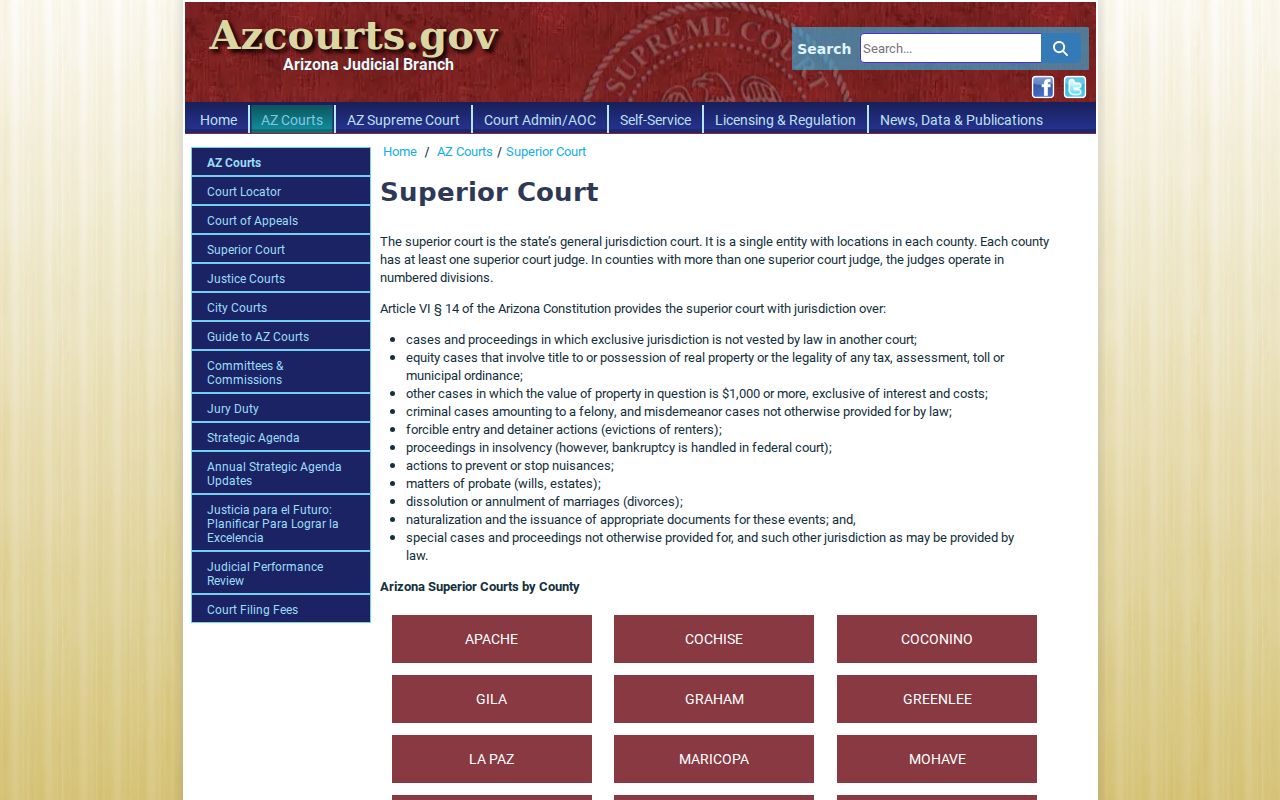
The state overview confirms that one Superior Court operates through county locations and local clerks.
Coconino Docket Caseloads Are Shifting
Felony filings in official county materials climbed from 1,051 in fiscal 2023 to 1,205 in fiscal 2024. They reached 1,389 in fiscal 2025. That is a 32.2 percent jump across two years. A 2026 administrative order split the felony caseload among Divisions I through III. It also reshuffled other assignments. Recovery Court moved to Division V in July 2026.
Assignments matter to a docket search. The newest judicial officer and division can differ from an older notice. So the case number is the safer key. Check the latest event and calendar instead of assuming a prior division still controls. Specialty court events usually sit under the underlying case number. Treatment or medical information can stay restricted.
Administrative orders change operations, not the legal meaning of a private case. Use them to see where settings and files are managed. Then rely on the actual docket and the clerk for a specific matter.
City-by-City Court Dockets in Coconino County
Every city keeps its own docket. So a Coconino County case lookup starts with the court named on the ticket or notice. Flagstaff, Page, Williams, Sedona, and Fredonia each run their own municipal court records. Each has separate contacts. In Page and Williams, the Municipal Court and Justice Court share one address. Even so, the two clerks keep their dockets apart. Sedona spills across the county line. That means the same address might route a docket search to either the Coconino or Yavapai Justice Court.
Flagstaff Court Records
Population 79,796 · municipal traffic, ordinance, and misdemeanor files
Page Court Records
Population 7,404 · separate Municipal and Justice clerks at one address
Williams Court Records
Population 3,608 · two lower courts with separate case files
Sedona Court Records
Coconino population 2,572 · a cross-county Magistrate Court route
Fredonia Court Records
Population 1,328 · Municipal and Justice matters remain distinct
The population counts come from Arizona Office of Economic Opportunity estimates dated July 1, 2025. They cover the five cities profiled. Still, the court printed on your citation decides which clerk holds the docket.
Map and Directions to the Coconino County Courthouse
Superior Court Divisions I through VI, the Clerk of Superior Court's counter, Flagstaff Justice Court, and the county Law Library all operate at the Coconino County Courthouse, 200 N. San Francisco Street, in downtown Flagstaff. The clerk's counter is the fallback for viewing the complete file, obtaining paper copies, and certification whenever Public Access or eAccess do not show a needed record. No official source reviewed described the counter's exact floor or room, so confirming the layout by phone before a visit is worthwhile.
Coconino County Courthouse
200 N. San Francisco St.
Flagstaff, AZ 86001
(928) 679-7600
Monday through Friday, 8:00 a.m. to 5:00 p.m.
Plan extra time for courthouse security screening and follow posted rules on devices and recording, since no official county page reviewed sets out a locker, camera, or parking policy. The Law Library, at (928) 679-7540 or (877) 806-3187, can help locate forms but is not the record custodian. Calling the clerk ahead confirms counter hours and whether the file being sought is available on-site.